
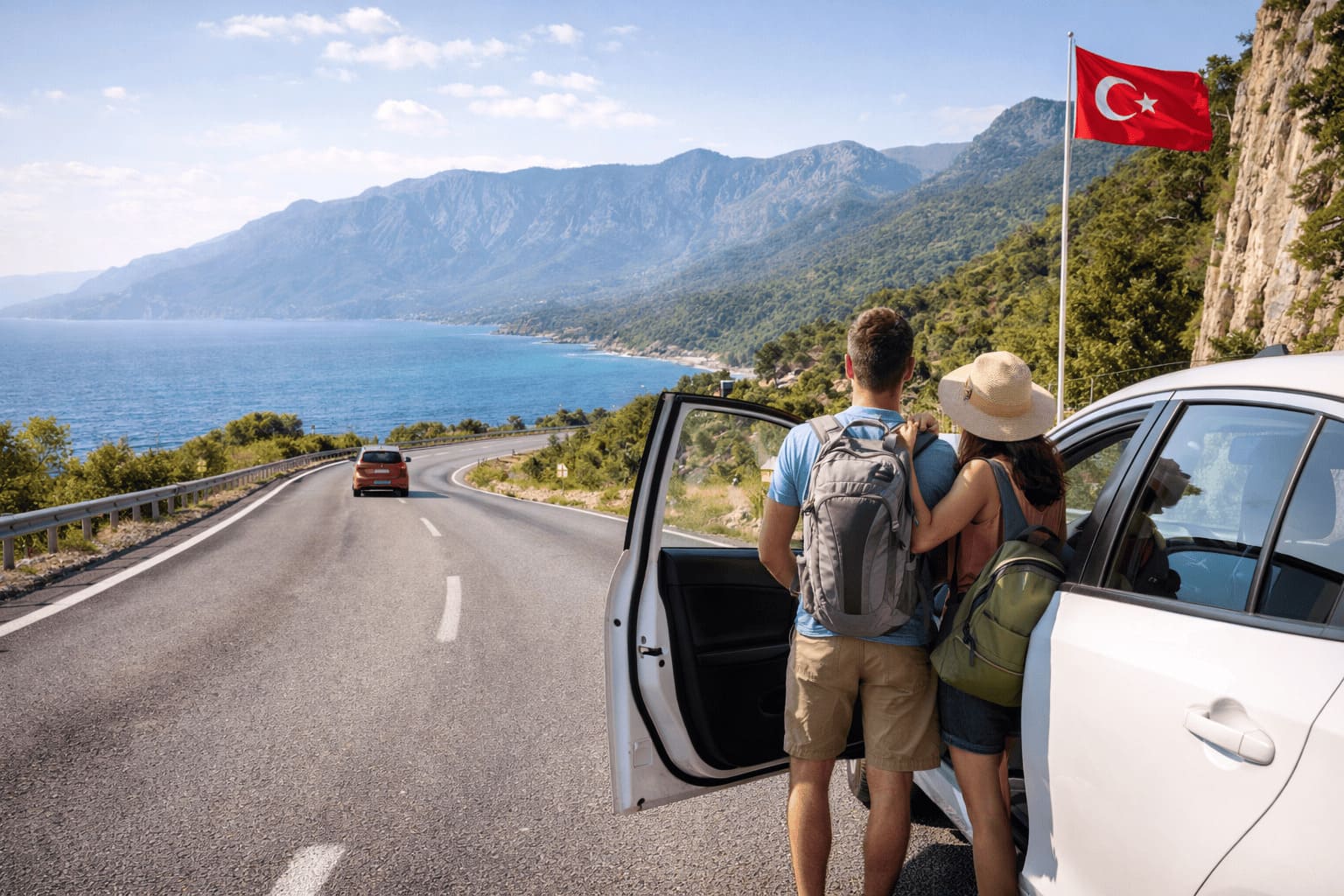
Turkey is more than twice the size of Germany, but most visitors see only a fraction of it. Package tours stay on a fixed circuit — Hagia Sophia, Ephesus, a boat trip off the coast. Travellers who arrange car rental Turkey in advance reach the places that define the country: the rock formations of Cappadocia at sunrise, the travertine terraces of Pamukkale without a tour group, the Aegean coastal road between Fethiye and Antalya with no schedule to keep.
What You Need to Rent a Car in Turkey
The standard requirements at Turkish rental counters are consistent across most operators:
- Minimum age: 21 years; some companies require 23 or 25 for premium categories
- Driving experience: at least one year of holding a full licence
- Documents: valid national licence, passport with entry stamp, and a credit card in the main driver’s name
- Young driver surcharge: applies to most drivers under 25, typically €5–10 per day extra
International Driving Permit (IDP): not required for stays under three months if the licence uses the Latin alphabet. UK, EU, US, and Australian licences are accepted without one. Drivers with licences in Cyrillic, Arabic, or Chinese script need an IDP.
One important point: Turkish rental cars cannot legally cross into neighbouring countries. Border crossings into Greece, Bulgaria, or Georgia are excluded under standard insurance terms. Confirm this before booking if a multi-country itinerary is planned.
Driving Rules in Turkey
Turkey drives on the right, following the same basic framework as continental Europe. Traffic signs follow international standards. A few rules deserve specific attention.
Speed limits:
- 50 km/h in urban areas
- 90 km/h on open roads outside towns
- 120 km/h on motorways
Rules with strict enforcement: seatbelts are mandatory for all passengers including rear seats; the alcohol limit is effectively zero; mobile phones are prohibited without a hands-free system; every rental car must carry a first aid kit, which rental companies typically include.
Turkey uses an electronic toll system on motorways and major bridges. Most rental companies provide a toll transponder with the vehicle. Ask about it at pickup — driving through toll gates without one creates billing complications that arrive after returning home. Traffic cameras monitor major highways continuously, with fines linked to the vehicle plate and billed through the rental agency.
Where to Rent — and Where Not to Drive
Skip the car in Istanbul. Traffic is genuinely dense, parking is difficult, and the metro and tram network covers most tourist destinations. Fly or take the bus between Istanbul and the first road trip base, then pick up the rental there.
Best pick-up cities for road trips:
- Antalya — for the Turquoise Coast, Termessos, and the Taurus Mountains
- Izmir / Dalaman — for the Aegean coast, Ephesus, Pamukkale, and Fethiye
- Kayseri / Nevşehir — for Cappadocia and central Anatolia
One-way rentals within Turkey are widely available, though a drop-off fee applies. Picking up in Izmir and returning in Antalya suits many itineraries without backtracking.
Road Quality and Regional Differences
Major highways between Turkey’s largest cities are in excellent condition — well-maintained, well-signed, and lit. Intercity distances are genuinely large. Istanbul to Ankara is 450 km (5–6 hours), Istanbul to Antalya is nearly 800 km (8 hours), and Antalya to Cappadocia is around 500 km (7 hours). These are not day trips.
Turkey attracted over 52 million foreign visitors in 2024 — one of the top five most visited countries in the world. The same source notes 21 UNESCO World Heritage Sites across the country, which helps explain why travellers stay longer than planned once they start driving between them.
Secondary roads on the Aegean and Mediterranean coasts are generally good but narrow. The Black Sea mountains and eastern Anatolia involve more challenging terrain, with some unpaved sections on minor routes. A 4WD is worth considering for anyone heading into mountain areas. Fuel stations are plentiful on motorways; in central and eastern Anatolia they become sparse — fill up before leaving any town on a rural leg.
The practical seasonal implication: July and August bring heavy tourist traffic on both coasts. Shoulder season — April, May, September, October — offers the same routes with significantly less congestion and rental prices roughly 40% lower than peak summer rates.
Practical Tips Before You Drive
Photograph everything at pickup. Go around the car methodically and document every mark before signing. This protects against disputed damage claims on return.
Download offline maps. Google Maps and Yandex Maps work well in Turkey. Signal is reliable on main routes but patchy in mountain areas. Download offline maps of the specific regions the night before setting out.
Keep documents accessible. Police checkpoints occur on major roads. Officers expect to see the driving licence, passport, and rental agreement. Carry the paper contract — a phone screenshot is not always accepted.
Watch for livestock on rural roads after dark. Animals on the road at night are a real hazard in central and eastern Anatolia. Plan mountain legs to finish before sunset.
Check the insurance excess. Basic Turkish rental rates often include CDW with a significant excess — sometimes €500–1,000. Super CDW, available at the rental counter, reduces this to zero for a daily surcharge. On a long road trip through varied terrain, the peace of mind is worth the extra cost.
CDW coverage reduces or eliminates the renter’s financial liability for damage to the vehicle — a particularly relevant consideration in Turkey, where basic rental rates often carry excess charges of €500–1,000. Super CDW, available at the counter, reduces this to zero for a daily surcharge and is worth considering on longer road trips.
FAQ
Do I need an International Driving Permit for Turkey?
Only if your licence does not use the Latin alphabet. EU, UK, US, and Australian licences are accepted without an IDP for stays under three months.
Can I cross into Greece or Bulgaria with a Turkish rental car?
No. Standard Turkish rental insurance explicitly excludes cross-border travel. Separate arrangements are needed for any multi-country itinerary.
What is the minimum rental age in Turkey?
21 years for most vehicles. Some companies require 23 or 25 for SUVs and premium cars. Drivers under 25 pay a young driver surcharge.
Is driving in Turkey safe?
Yes on main highways, which are well-maintained. City driving — especially Istanbul — is congested and better avoided with a rental car. Rural mountain roads require experience and a suitable vehicle.
What emergency number should I call in Turkey?
112 for medical emergencies, 155 for police, 110 for fire.